Hand-painted in oil
About this Artwork
The body, by itself
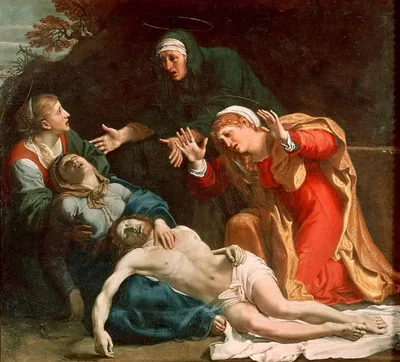
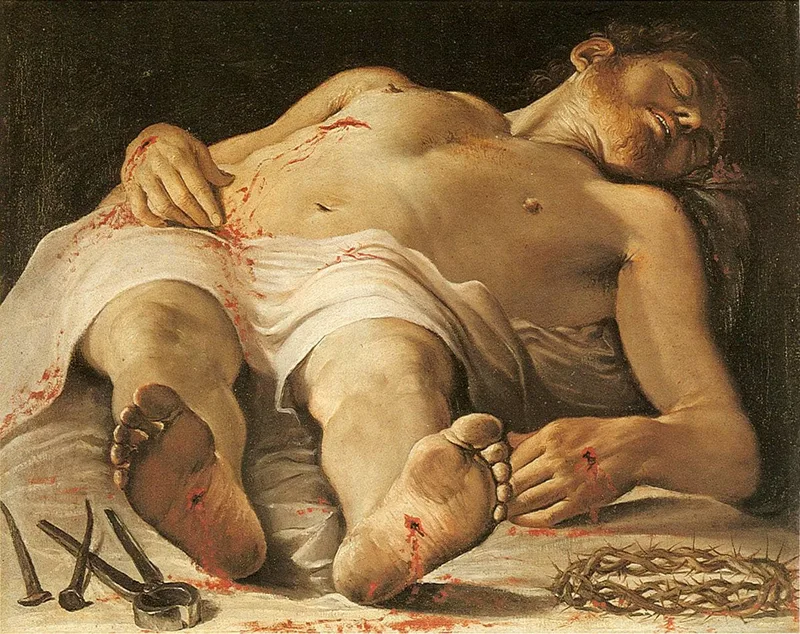
Between the deposition and the entombment painting opened an interval the gospels pass over in a sentence, and filled it with a family of subjects: the Lamentation with mourners, the Pietà with the mother alone, and the dead Christ shown with no one at all. A title that names only the corpse belongs to the third. It is the most reduced of the three, and the closest to an object of contemplation rather than a scene.
Where it falls
After the Crucifixion, before the tomb. Thirty-seven titles in this catalogue name a lamentation, a pietà, a dead Christ or a corpse, against twelve that carry the word resurrection. The proportion is not accidental: the three days between the cross and the empty tomb were where devotional practice concentrated, and painting followed.
The record
The catalogue gives Annibale Carracci, 1585, and the Staatsgalerie Stuttgart, at 70.7 by 88.8 centimetres — a small horizontal, the format that follows from a subject laid out lengthwise. The style is entered as Baroque and the artist as Italian; the subject fields class the work as a male figure and as religious. The measured palette reads as ochre and yellow. No provenance appears in the record.
Sources
2 references- Carracci, Annibale — Getty ULAN
Italian painter, 1560-1609
- Corpse of Christ — Wikipedia
The Corpse of Christ is a painting by the Italian Baroque master Annibale Carracci, dating to c. 1583–1585. It is currently housed in the Staatsgalerie of Stuttgart, Germany. The work, dating to Carracci's early career, is a manifest homage