Hand-painted in oil
About this Artwork
Ecce Homo
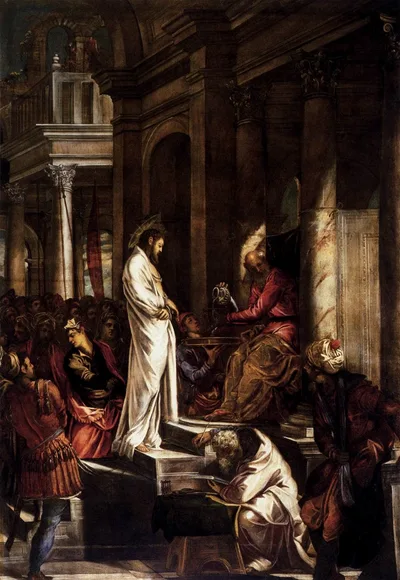
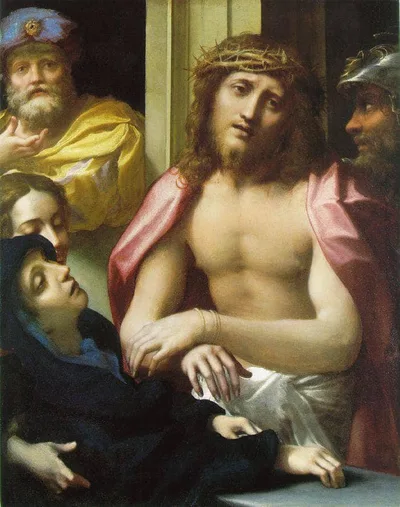
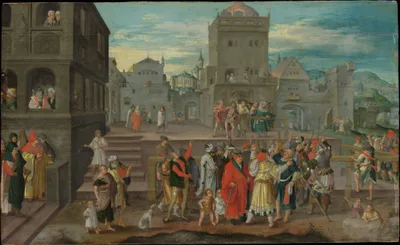
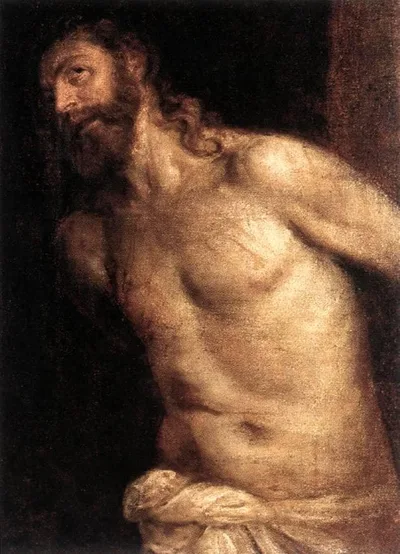
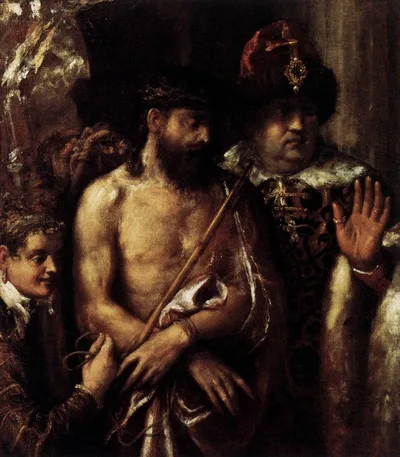
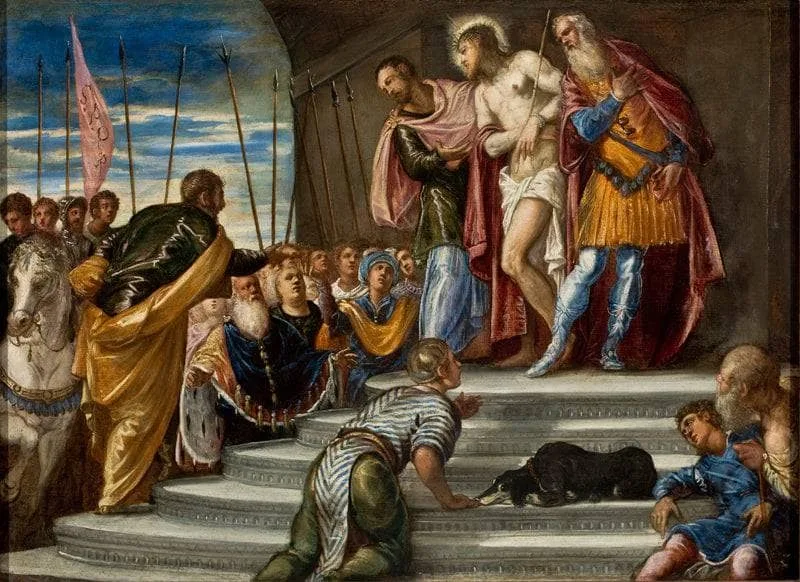
The scene is the presentation to the crowd in the nineteenth chapter of John. After the scourging Christ is brought out wearing the crown of thorns and a purple robe, and Pilate says behold the man. The convention that follows is a raised platform, a governor gesturing, a bound figure beside him, and a crowd below — the only Passion episode that formally requires an audience inside the picture.
Its place in the sequence
Between the flagellation and the sentence. It is the last moment at which the outcome is still presented as undecided; the shouting of the crowd that follows settles it, and the road to Calvary begins immediately after.
What the record holds
The catalogue gives Tintoretto, 1547, and the Museu de Arte de Sao Paulo in Brazil. It measures 109 by 136 centimetres, horizontal. The style is entered as Mannerism and late Renaissance and the artist as Italian; the subject fields class the work as a group composition and as religious. The measured palette reads as brown. The record does not carry a provenance note, and none is supplied here.
Sources
5 references- Tintoretto and Domenico Tintoretto — Getty ULAN
artist, active 20th century
- Tintoretto — Wikipedia
Jacopo Robusti (late September or early October 1518 – 31 May 1594), best known as Tintoretto ( TIN-tə-RET-oh; Italian: [tintoˈretto]; Venetian: [tiŋtoˈɾeto]), was an Italian Renaissance painter of the Venetian school. His contemporaries bo
- Tintoretto, Marco — Getty ULAN
Italian painter, 1561-1637
- Ecce homo — Wikipedia
Ecce homo (, Ecclesiastical Latin: [ˈettʃe ˈomo], Classical Latin: [ˈɛkkɛ ˈhɔmoː]; "behold the man") are the Latin words used by Pontius Pilate in the Vulgate translation of the Gospel of John, when he presents a scourged Jesus, bound and c
- Tintoretto - ecce homo masp — Wikimedia Commons
High-resolution image of the work, hosted on Wikimedia Commons.