Hand-painted in oil
About this Artwork
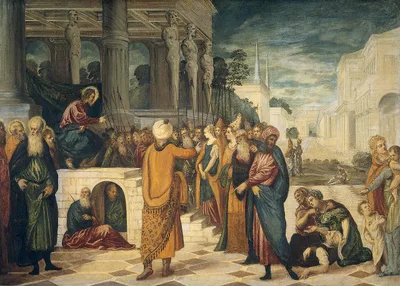
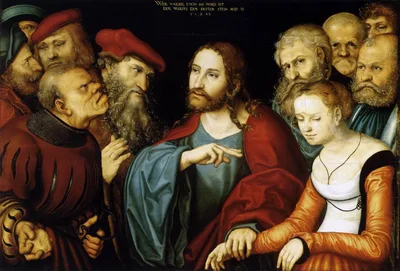
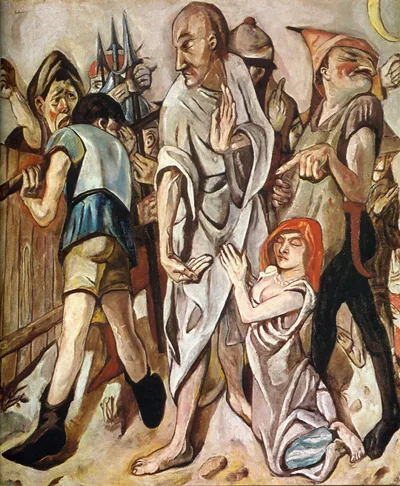
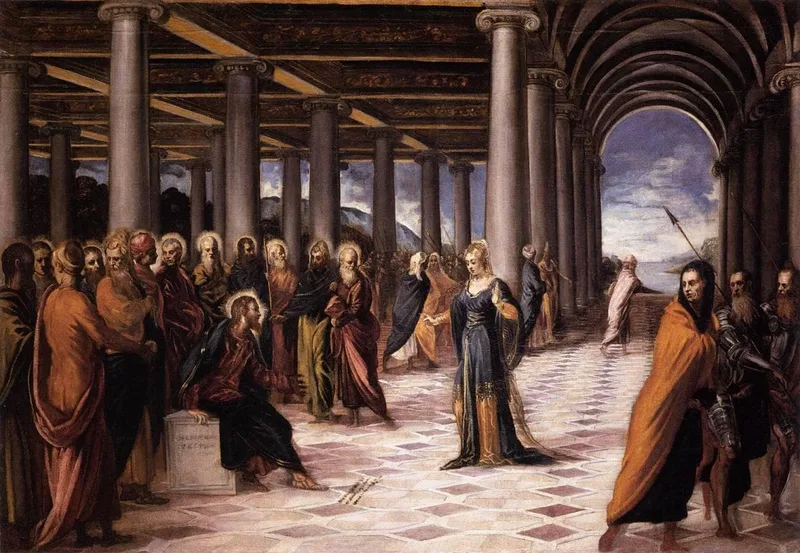
The woman taken in adultery
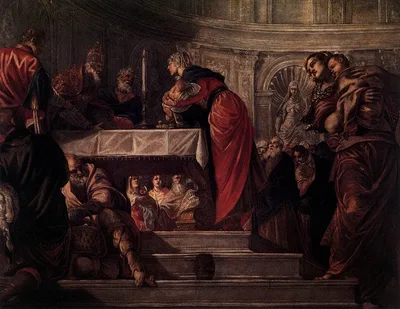
The episode opens the eighth chapter of John. A woman is brought before Christ in the temple precinct by men demanding the penalty of the law; he writes on the ground, says that whoever is without sin should throw the first stone, and the accusers leave. The scene is a semicircle of figures around two: the accused and the one who is asked to judge. Its architecture matters, because the gospel sets it in the temple.
Its place in the sequence
Late ministry, in Jerusalem, among the episodes of public confrontation that lead toward the arrest. It belongs with the cleansing of the temple and the disputes with the authorities rather than with the Galilean miracles, and in a cycle read in order it is one of the last scenes before the Passion begins.
The catalogue record
The entry names Tintoretto, dates the work to 1550, and gives the National Gallery of Ancient Art in Rome as the location. It measures 119 by 168 centimetres, a horizontal canvas at the scale of a large room picture. The style is classed as Mannerism and late Renaissance, the artist as Italian, and the subject fields include an architectural classification alongside the religious ones. The measured palette reads as red.
Sources
1 references- Tintoretto and Domenico Tintoretto — Getty ULAN
artist, active 20th century