Hand-painted in oil
About this Artwork
The eighth day
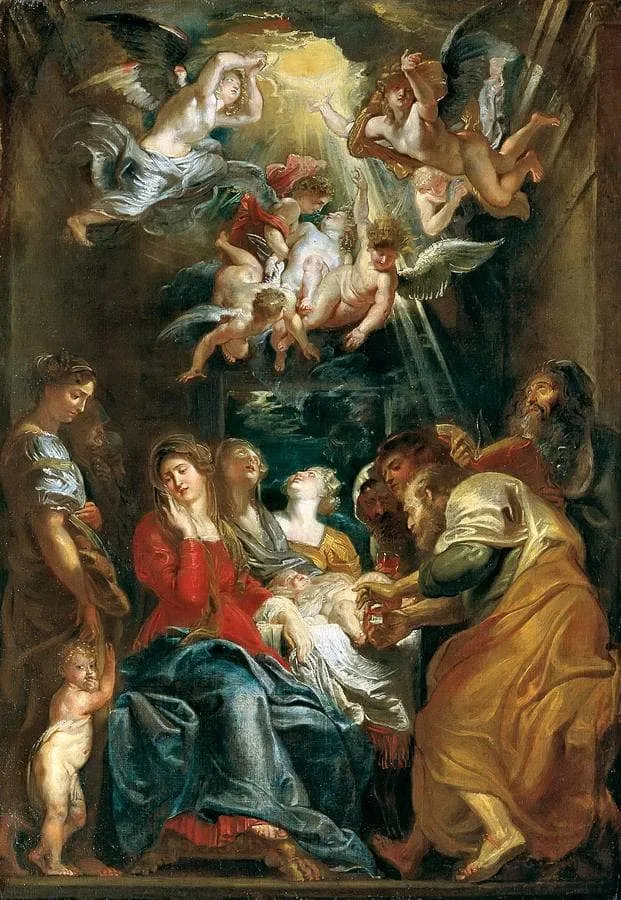
The Circumcision is the first event of the Christ cycle after the Nativity itself. Luke gives it in a single verse: on the eighth day the child was circumcised and given the name Jesus. In painting it became a temple scene with a priest, the parents, and attendants, and it carries a weight beyond the rite, because it is the first time blood is shed in the story. Cycles that pair beginning and end use it as the answering scene to the Passion.
Where it sits
Between the Nativity and the Presentation in the Temple, which follows on the fortieth day. The two temple scenes are close together in the calendar and easily confused; the Circumcision turns on the naming and the rite, the Presentation on Simeon and the prophecy of Anna.
The record
The catalogue names Peter Paul Rubens, dates the work to 1605, and lists two locations: the Academy of Fine Arts in Vienna, Austria, and the Chiesa del Gesu e dei Santi Ambrogio e Andrea in Genoa, Italy. The entry gives 105 by 74 centimetres, an upright format, and classes the style as Baroque and the artist as Flemish. The measured palette reads as brown. The record does not resolve the relationship between the two listed locations, and this page does not guess at it.
Sources
4 references- Rubens, Peter Paul — Getty ULAN
Flemish painter, 1577-1640
- The Circumcision of Christ — Wikidata
description: painting by Peter Paul Rubens; inception: 1605-01-01; dimensions: 105 × 74 cm; collection: Chiesa del Gesù e dei Santi Ambrogio e Andrea
- The Circumcision (Rubens) — Wikipedia
The Circumcision is an oil on canvas painting of the Circumcision of Jesus by Peter Paul Rubens, produced in 1605 during his stay in Rome. It is now in the Chiesa del Gesù e dei Santi Ambrogio e Andrea church in Genoa. It was commissioned b
- Peter Paul Rubens - The circumcision of Christ — Wikimedia Commons
High-resolution image of the work, hosted on Wikimedia Commons.