Hand-painted in oil
About this Artwork
Which Simon
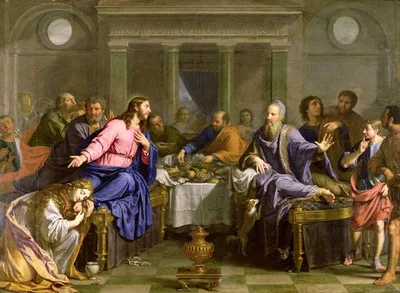
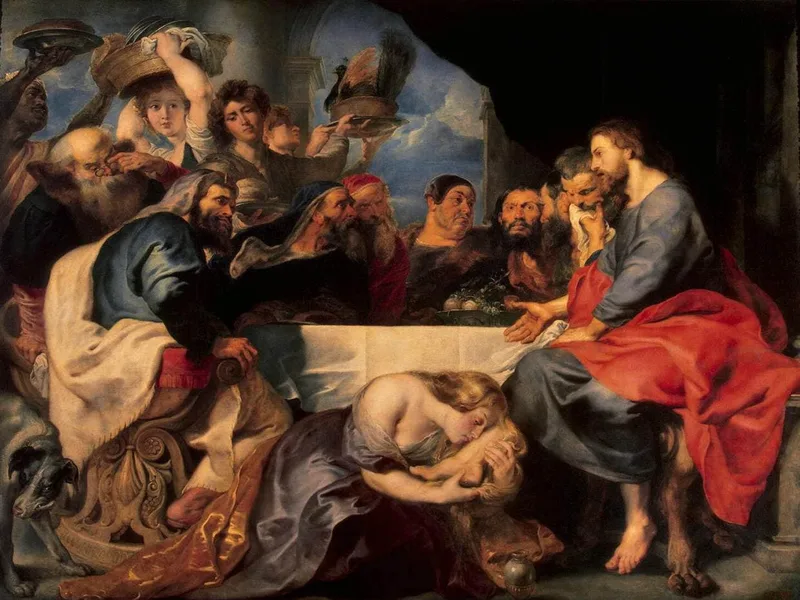
The gospels contain more than one meal at the house of a man named Simon, and painting has often merged them. Luke's seventh chapter places the meal at the house of Simon the Pharisee, where a woman of the city washes Christ's feet with her tears and anoints them, and the host objects silently. Matthew and Mark set a later anointing at Bethany, in the house of Simon the leper, days before the Passion. This entry is titled for the Pharisee, which fixes it in Luke.
Where it falls
In the ministry, well before Jerusalem — not in the last week, where the Bethany anointing belongs. The distinction changes the meaning of the scene: at the Pharisee's table the subject is forgiveness, and at Bethany it is the anointing for burial.
The record
The catalogue gives Peter Paul Rubens, 1620, and the Hermitage Museum in Saint Petersburg — one of seven entries here in that collection. It measures 189 by 254.5 centimetres, a wide horizontal at over life size, which is the scale a banquet composition needs. The style is entered as Baroque and the artist as Flemish. The measured palette reads as brown. No commission is recorded.
Sources
4 references- Rubens, Peter Paul — Getty ULAN
Flemish painter, 1577-1640
- The Feast in the House of Simon the Pharisee (Rubens) — Wikipedia
Feast in the House of Simon the Pharisee, also known as Christ in the Home of Simon the Pharisee, is a painting by Peter Paul Rubens. It was painted c. 1618–1620, and is in The Hermitage Museum, St. Petersburg. The painting depicts an incid
- Rubens-Feast of Simon the Pharisee — Wikimedia Commons
High-resolution image of the work, hosted on Wikimedia Commons.
- Peter Paul Rubens — Wikipedia
Sir Peter Paul Rubens ( ROO-bənz; Dutch: [ˈpeːtər pʌul ˈrybəns]; 28 June 1577 – 30 May 1640) was a Flemish artist and diplomat. He is considered the most influential artist of the Flemish Baroque tradition. Rubens's highly charged compositi