Hand-painted in oil
About this Artwork
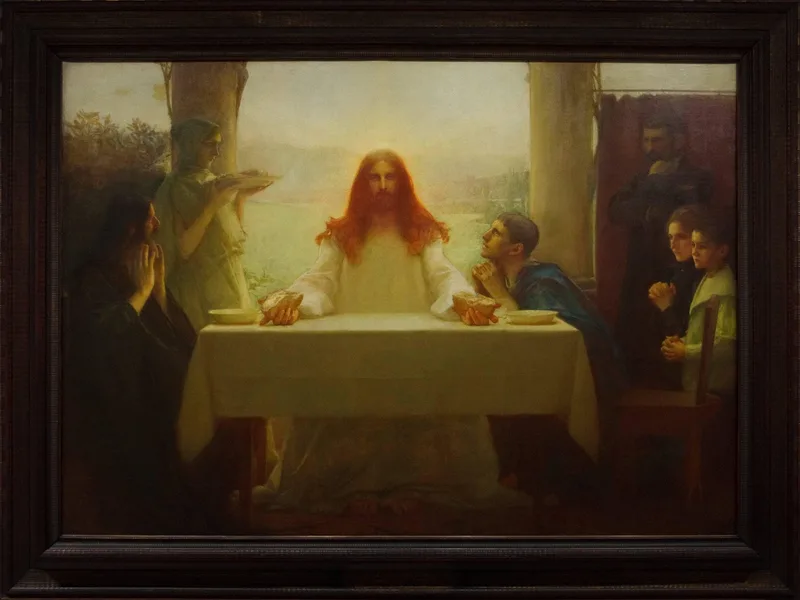
The supper at Emmaus
Luke's last chapter gives it. On the evening of the Resurrection two disciples walk to a village and are joined by a stranger who explains the scriptures to them; at table he breaks bread, they recognise him, and he vanishes. The episode is built entirely around a delay in recognition, and painting fixed it at the instant the bread is broken, because that is the only visible sign the text provides.
Where it falls in the cycle
On the Sunday, among the appearances, after the empty tomb and before the Ascension. It is the only work in this catalogue whose title names Emmaus — a single entry against twenty-five Lamentations, which is a fair picture of how the tradition weighted the mourning over the aftermath.
The record
The catalogue names Pascal Dagnan-Bouveret, dates the canvas to 1897, and places it in the Carnegie Museum of Art, Pittsburgh, PA, US. It measures 198.1 x 280.6 cm, a wide horizontal at exhibition scale. Two styles are entered, Academicism and Naturalism, and the artist is recorded as French; the subject fields class the work as religious. The measured palette reads as brown and yellow. No commission, exhibition history or earlier owner appears in the entry.
Sources
1 references- Dagnan-Bouveret, Pascal Adolphe Jean — Getty ULAN
French painter and printmaker, 1852-1929