Hand-painted in oil
About this Artwork
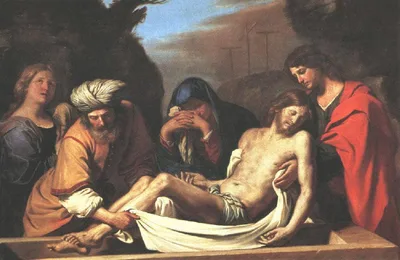
The entombment
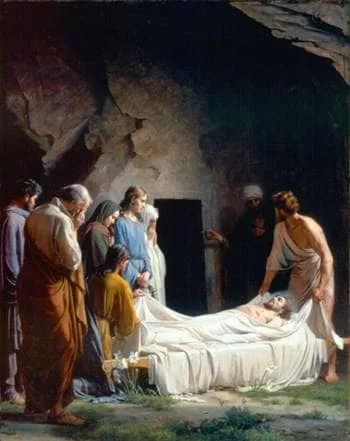
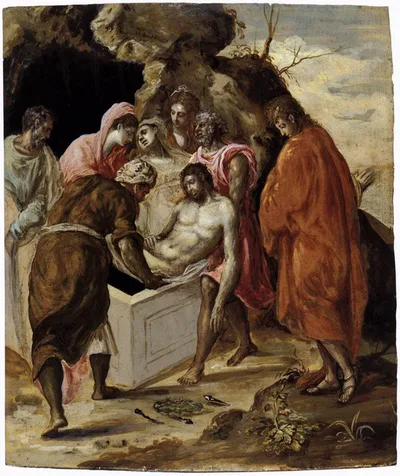
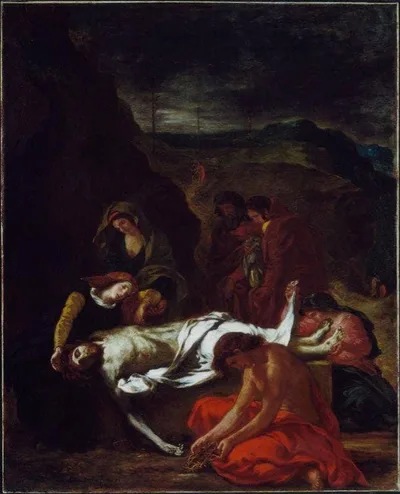
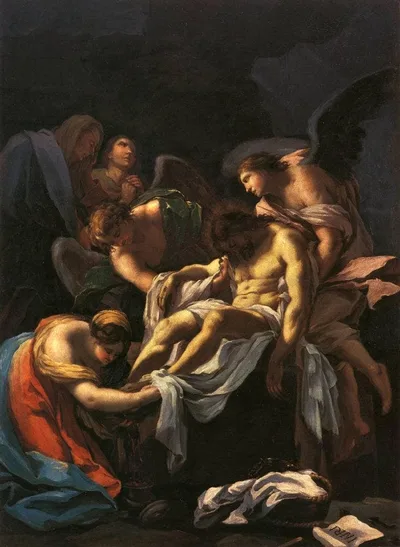
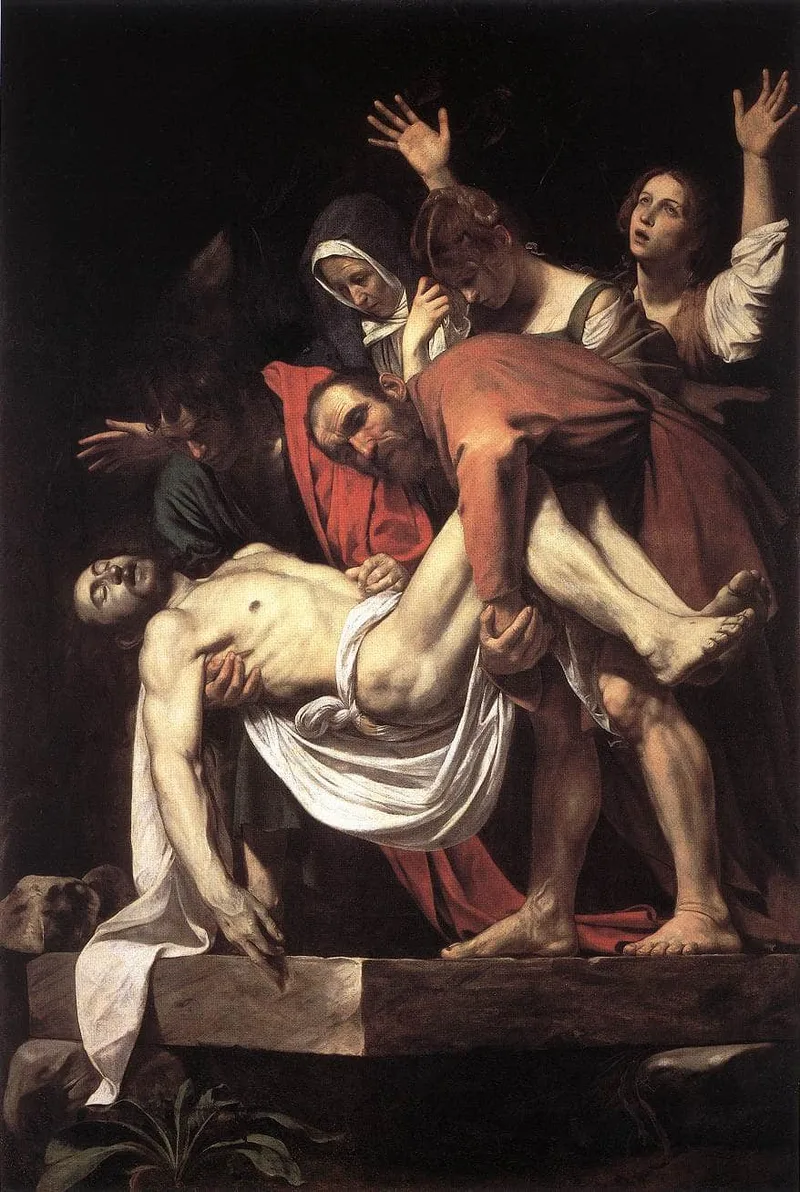
The burial is the last episode of the Passion. Joseph of Arimathea asks Pilate for the body; in John's account Nicodemus brings spices, and the body is wrapped and laid in a new tomb nearby because the sabbath is beginning. The pictorial convention is a group carrying or lowering the body, with the stone of the tomb usually visible as the destination of the movement.
Its place in the sequence
After the lamentation and immediately before the sabbath silence that separates the Passion from the Resurrection. It closes the part of the cycle in which other people handle the body, and the next scene in the narrative has no witnesses in it at all.
The catalogue entry
The record names Caravaggio, dates the work to 1603, and gives the Vatican Museums as the location. It measures 300 by 203 centimetres — an upright altar-scale canvas. The style is classed both as Baroque and as tenebrism, and the artist as Italian. The subject fields carry the religious classifications. The measured palette reads as red. The record notes no patron and no church of origin, so none is stated here.
Sources
10 references- Caravaggio, Gianni — Getty ULAN
Italian sculptor and installation artist, born 1968
- Caravaggio — Wikipedia
Michelangelo Merisi da Caravaggio (also Michele Angelo Merigi or Amerighi da Caravaggio; 29 September 1571 – 18 July 1610), known mononymously as Caravaggio, was an Italian painter active in Rome for a significant portion of his artistic li
- Caravaggio, Cecco del — Getty ULAN
Italian painter, active ca. 1610-1620
- The Entombment of Christ — Wikidata
description: painting by Caravaggio; inception: 1602-01-01; dimensions: 300 × 203 cm; collection: Pinacoteca Vaticana
- beckchris.wordpress.com — record for "The Entombment of Christ"
Primary source record for this work (beckchris.wordpress.com).
- The Entombment of Christ (Caravaggio) — Wikipedia
The Entombment of Christ is an oil on canvas painting by Caravaggio, from 1603–1604. It was created for the second chapel on the right in Santa Maria in Vallicella (the Chiesa Nuova), a church built for the Oratory of Saint Philip Neri. A c
- museodelprado.es — reference for "The Entombment of Christ (Caravaggio)"
Authoritative source for this work (museodelprado.es).
- library.nga.gov — reference for "The Entombment of Christ (Caravaggio)"
Authoritative source for this work (library.nga.gov).
- nga.gov — reference for "The Entombment of Christ (Caravaggio)"
Authoritative source for this work (nga.gov).
- The Entombment of Christ-Caravaggio (c.1602-3) — Wikimedia Commons
High-resolution image of the work, hosted on Wikimedia Commons.