Hand-painted in oil
About this Artwork
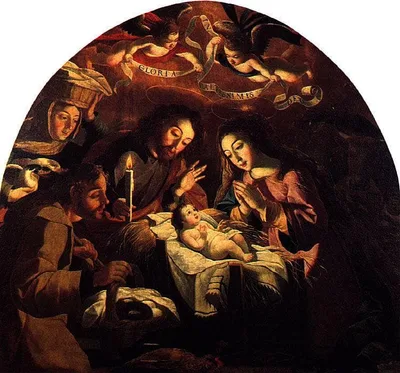
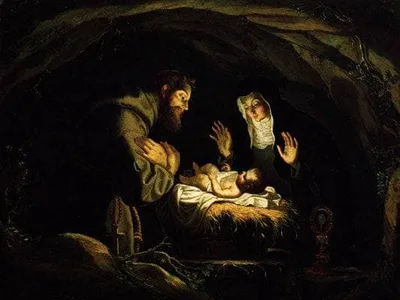
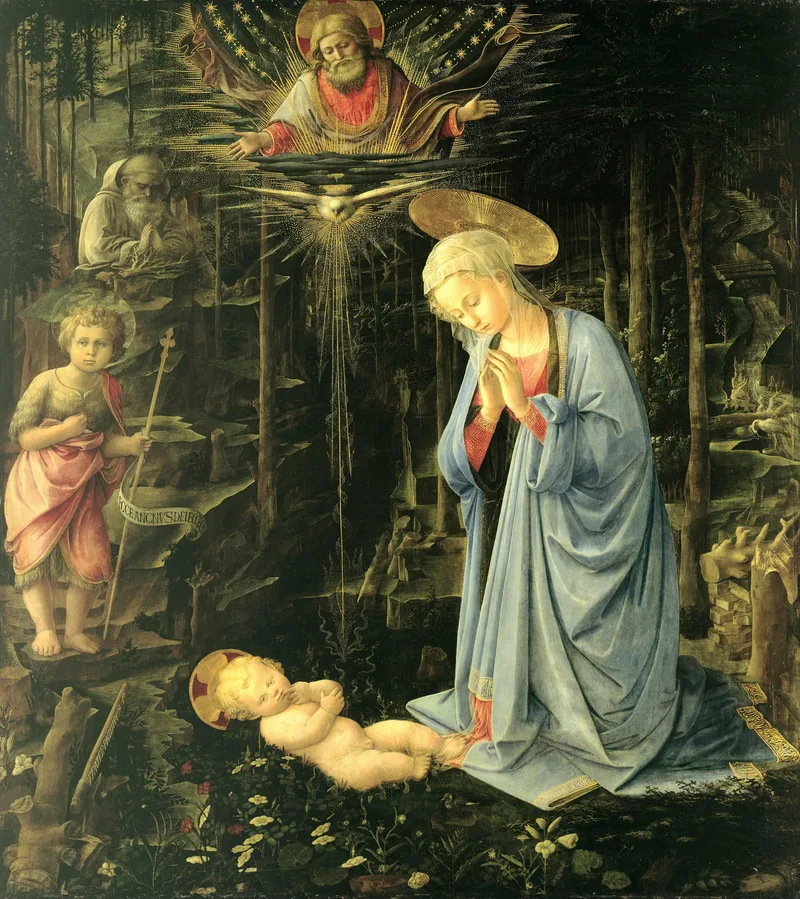
The Nativity in its adoring form
The Adoration of the Child is the devotional version of the birth. Instead of the mother resting after the delivery, which is the older way of showing the night at Bethlehem, the newborn is laid on the ground and the mother kneels. Worship replaces childbed. The recorded title names that variant rather than the Nativity in general.
Where it falls in the cycle
At the beginning. Only the Annunciation and the journey to Bethlehem come before it, and everything the cycle later depends on follows: the Circumcision, the Presentation, the hidden years, the ministry, the Passion. Six titles in this catalogue use the word adoration, which covers both the adoration of the child and the arrival of the Magi that follows it.
What the record holds
The catalogue gives Filippo Lippi as the painter, 1459 as the date of creation, and the Staatliche Museen zu Berlin, Berlin, Germany, as the location. It measures 129.5 x 118.5 cm, close to square and at altar scale. The style is entered as Early Renaissance and the artist as Italian; the subject fields class the work under portraits and as religious. The measured palette reads as yellow and green. The record says nothing about the chapel or patron the panel served, so nothing of that is claimed here.
Sources
3 references- Filippo Lippi — Wikipedia
Filippo Lippi (c. 1406 – 8 October 1469), also known as Lippo Lippi, was an Italian Renaissance painter of the Quattrocento (fifteenth century) and a Carmelite priest. He was an early Renaissance master of a painting workshop, who taught ma
- Lippi, Filippo — Getty ULAN
Italian painter, ca.1406-1469
- Adoration of the Magi (Fra Angelico and Filippo Lippi) — Wikipedia
The Adoration of the Magi is a tondo, or circular painting, of the Adoration of the Magi assumed to be the work recorded in 1492 in the Palazzo Medici Riccardi in Florence as by Fra Angelico. It dates from the mid-15th century and is now in