Hand-painted in oil
About this Artwork
The stripping of the garments
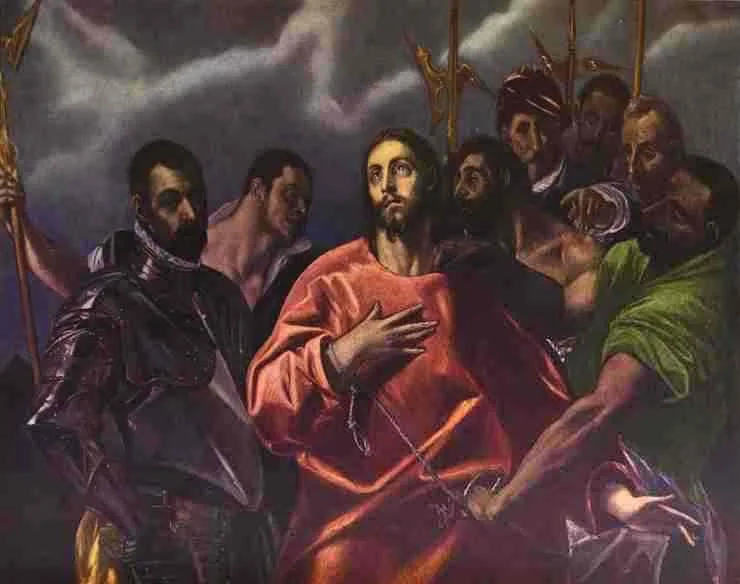
The subject is the moment on Calvary, before the nailing, when Christ is stripped of his robe. The gospels record it obliquely, through the soldiers who divide the clothing and cast lots for the seamless tunic. Spanish painting made it a subject in its own right under the name Espolio, and its fixed elements are a red-robed central figure, a press of heads behind, and a man at the lower edge preparing the wood of the cross.
Its place in the Passion
Between the road to Calvary and the raising of the cross — the narrowest gap in the whole cycle, and the last episode in which Christ is shown upright and clothed. Cycles that include it place it directly before the Crucifixion.
What the record holds
The catalogue gives El Greco as the artist and 1579 as the date of creation, and records the location as Toledo Cathedral, Toledo, Spain — a working church rather than a museum. It measures 165 by 99 centimetres, an upright format. The style is entered as Mannerism and late Renaissance and the artist as Spanish. The measured palette reads as red and pink, which is consistent with the robe that identifies the subject.
Sources
5 references- Greco, Nicolás — Getty ULAN
Spanish artist, active late 16th - early 17th century
- The Disrobing of Christ — Wikidata
description: painting by El Greco in the Alte Pinakothek; inception: 1583-01-01; dimensions: 165 × 98.8 cm; collection: Bavarian State Painting Collections
- sammlung.pinakothek.de — record for "The Disrobing of Christ"
Primary source record for this work (sammlung.pinakothek.de).
- The Disrobing of Christ — Wikipedia
The Disrobing of Christ or El Expolio (Latin: Exspolĭum) is a painting by El Greco begun in the summer of 1577 and completed in the spring of 1579 for the High Altar of the sacristy of the Cathedral of Toledo, where it still normally hangs.
- The Disrobing of Christ - El Greco — Wikimedia Commons
High-resolution image of the work, hosted on Wikimedia Commons.