Hand-painted in oil
About this Artwork
The episode: the well at Sychar
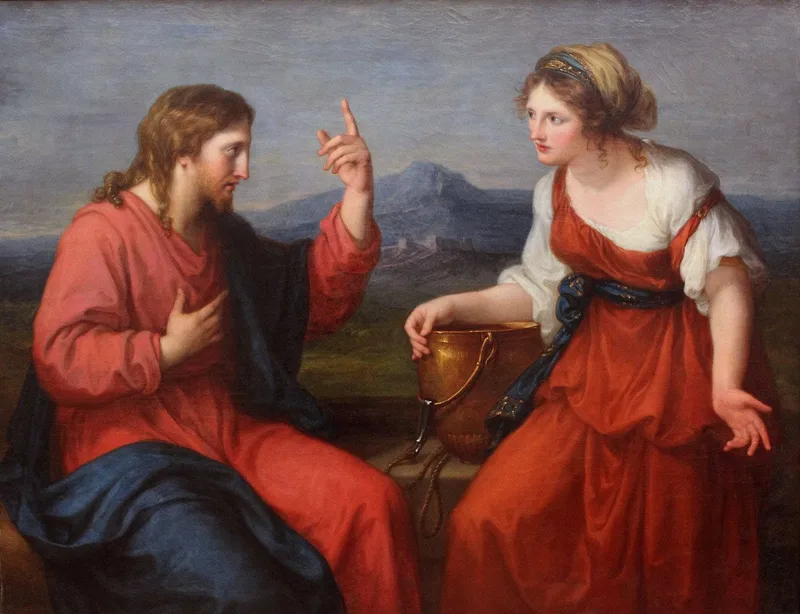
John's fourth chapter gives the longest conversation in the gospels. Christ, resting at a well in Samaria, asks a woman drawing water for a drink, and the exchange turns to living water. There is no miracle in it and no crowd. The iconography is fixed by three things only — the well, a vessel, and two figures on either side of it.
Where it falls in the cycle
Early in the public ministry, among the encounter scenes rather than the healings. Three works in this catalogue name the Samaritan in the title, and they sit at the same point of the sequence: after the baptism, long before Jerusalem. What varies is the register, and a late eighteenth-century treatment approaches the episode as a two-figure subject in the manner of a classical group rather than as a religious narrative.
What the record gives
The catalogue names Angelica Kauffman, dates the work to 1796, and places it in the Neue Pinakothek, Munich, Germany. It measures 123.5 x 158.5 cm, horizontal. The style is entered as Neoclassicism and the artist as Swiss. The subject fields class the work under male and female figures, and not under religion — a filing that matches the way the period treated the subject. The measured palette reads as red.
Sources
3 references- Kauffmann, Angelica — Getty ULAN
Swiss painter and printmaker, 1741-1807
- Angelica Kauffman — Wikipedia
Maria Anna Angelika Kauffmann ( KOWF-mən; 30 October 1741 – 5 November 1807), usually known in English as Angelica Kauffman, was a Swiss painter who had a successful career in London and Rome. Remembered primarily as a history painter, Kauf
- Christ and the Samaritan Woman (Kauffman) — Wikipedia
Christ and the Samaritan Woman at the Well is a painting in oils on canvas of 1796 by Angelica Kauffman, depicting the eponymous Gospel passage. It was bought from the artist's estate in 1829 by Louis I of Bavaria and remained in the House