
Pietà, Lamentation and Entombment: What Is the Difference?
Published · Art & See editorial desk
Pietà, Lamentation and Entombment describe closely connected images after Christ’s death. They are not three perfectly sealed boxes. Museum records can use Pietà and Lamentation together, while an Entombment may also be designed to invite contemplation of the dead Christ. [1][2]
Pietà and Lamentation can overlap
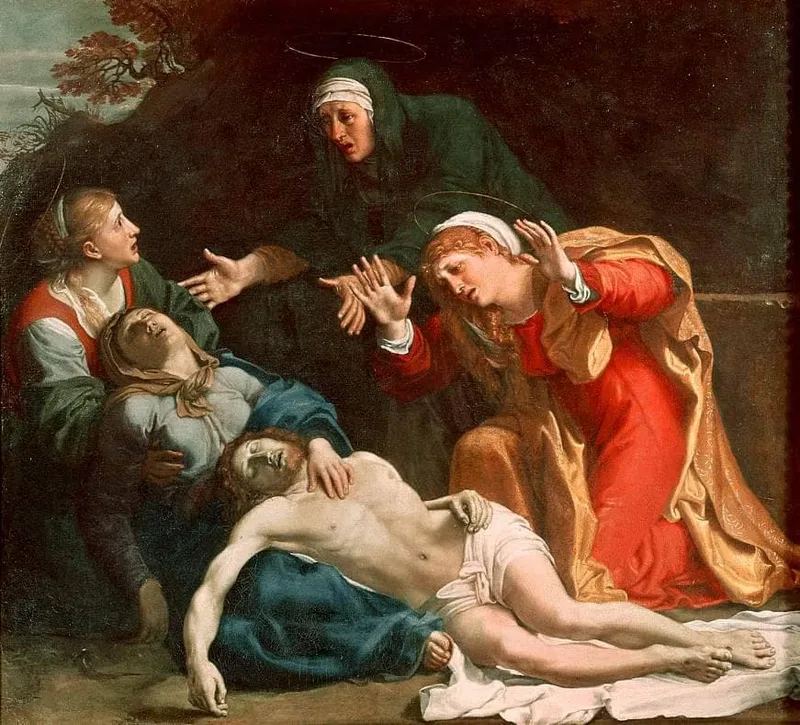
Annibale Carracci’s The Dead Christ Mourned (The Three Maries), about 1604, provides a clear example. The National Gallery describes the picture as a pietà and explains it as mourning over the dead Christ. His body rests in the Virgin’s lap while other women respond to the loss. The institution’s wording allows the terms to overlap within one documented work. [1]
The painting is recorded as NG2923. Retaining that identifier and the full catalogue title is more useful than silently replacing its name with whichever thematic label a website happens to prefer. A topic heading can help explain the picture without becoming a new claim about its official title.
Entombment centres on carrying or burial
Michelangelo’s The Entombment (or Christ being carried to his Tomb), about 1500–1, is National Gallery inventory NG790. The Gallery identifies the action as the transport of Christ’s body towards a tomb. The picture is unfinished, and several proposed identifications of the surrounding people remain qualified rather than certain. [2]
The same record explains that the upright presentation of Christ can have a devotional function as well as a narrative one. An image may therefore describe an action and invite contemplation at the same time. “Devotional” should not be treated as the opposite of all storytelling. [2]


Do not confuse removal from the Cross with burial
Ugolino di Nerio’s The Deposition, National Gallery NG3375, supplies a neighbouring episode. Here the body is being taken down from the Cross. The Gallery identifies Saint John holding Christ and places the panel in the predella of the Santa Croce altarpiece. Removal from the Cross and transport towards a tomb are successive actions, even when related works use similar mourners or gestures. [3]


A comparison method for uncertain titles
Ask what the figures are doing: supporting the body during removal, mourning beside it, or carrying it towards burial. Next read the institution’s title, alternate title and description. Use those together rather than judging the whole subject from one person’s pose.
Keep three questions distinct. The subject concerns the represented event or devotional theme. Identity concerns which physical artwork the record describes. Attribution concerns who made it. A disagreement over an artist does not automatically change the subject, and a shared subject does not prove that two records describe the same painting.
| Scene | The action | Where the body is | Who holds or supports it | Who else is there |
|---|---|---|---|---|
| Deposition | The body is being taken down from the Cross; the nails are still being pulled out [3] | Still at the Cross, collapsing as it comes free [3] | Saint John the Evangelist clutches him and the Virgin catches him, placing her face against his [3] | A man on the ladder, probably Joseph of Arimathea; a man at the feet, possibly Nicodemus; Mary Magdalene and other women [3] |
| Pietà | Mourning over the dead Christ after the Crucifixion [1] | At rest, lying in the Virgin's lap [1] | The Virgin Mary [1] | Mary Magdalene kneeling, hands raised and mouth open, with the other women [1] |
| Lamentation | The same mourning; the National Gallery uses the word for NG2923 in the same sentence as pietà [1] | At rest, in the Virgin's lap in this painting [1] | The Virgin Mary in this painting [1] | The women closest to Christ — whose mourning, the Gallery notes, is recounted in none of the four Gospels [1] |
| Entombment | The body is carried towards the tomb [2] | Held upright and carried, in Michelangelo's panel up a step towards a tomb in the rocks [2] | Figures carrying him on strips of winding cloth; the Gallery's identifications stay qualified [2] | A man behind Christ, either Joseph of Arimathea or Nicodemus; women on both sides [2] |
Actions, positions and identifications as given in the three National Gallery records this guide cites: NG3375 for the Deposition, NG2923 for the pietà and the lamentation, NG790 for the Entombment. [1][2][3] The middle two rows describe one documented painting, not two sealed categories — that is the point of the overlap.