
Devotional Images of Christ: Identifying the Type
Published · Art & See editorial desk
A devotional image invites attention to Christ as an object of prayer or contemplation. That purpose does not, by itself, identify a particular episode. Salvator Mundi, Man of Sorrows and Ecce Homo answer different questions about how Christ is presented. [1][2][3]
Salvator Mundi: Christ blessing
The National Gallery’s glossary explains Salvator Mundi as “Saviour of the World” and associates the type with close views of Christ, frequently blessing the viewer. It describes such images as aids to personal devotion. [1]
Andrea Previtali’s Salvator Mundi, dated 1519, gives the general term a specific object. Christ holds a crystal orb topped by a cross and raises his other hand in blessing. The National Gallery connects the orb with Christ’s rule on earth. The picture is NG2501; its documented features should not be transferred automatically to every work called Christ Blessing. [2]

,_oil_on_poplar,_61.6_x_53_cm,_National_Gallery.jpg)
Man of Sorrows: concentrating on suffering
The Metropolitan Museum of Art’s The Man of Sorrows, attributed to the workshop of Aelbert Bouts and dated about 1525, focuses on Christ’s wounds and suffering. The Met relates that emphasis to contemporary devotional writing. Keeping “workshop of” in the attribution matters: a familiar subject does not establish authorship by the named master himself. [3]
An intimate view can give wounds, expression and the viewer’s encounter with the figure unusual prominence. To identify another example, consult the catalogue’s name for the type. A crown of thorns alone is not enough to distinguish every closely related Passion image.


Ecce Homo: a phrase with a narrative setting
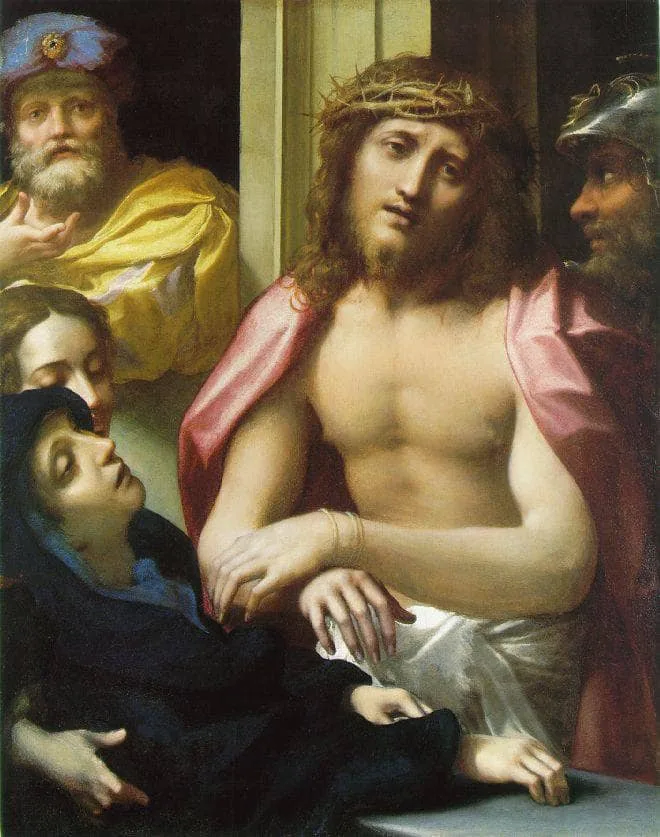
The National Gallery traces Ecce Homo, “Behold the man,” to Pilate’s presentation of Christ in John 19:5. In Correggio’s Christ presented to the People, Pilate appears behind the bound Christ and gestures as he speaks. This supplies a specific narrative setting as well as an invitation to the viewer to confront Christ’s suffering. [4][5]
The Gallery notes that Correggio includes the swooning Virgin although the Gospel does not place her in this moment. A painting can combine a textual episode with additional devotional imagery. It need not function as a literal illustration of every detail in one passage. [5]
Read purpose, type and episode separately
Begin with the exact title and attribution, then identify what the institution says about the figure’s gesture, objects and companions. Finally ask how the image addresses its viewer. These steps allow a picture to be devotional and narrative without forcing it into a single rigid category.
When a source simply calls a work Christ on the Cross, retain that title. Do not rename it Man of Sorrows merely because it emphasises suffering. A useful comparison explains similarities while preserving the identity of each individual work.
| Type | What the image shows | What to look for | Does it fix a narrative moment? | Example named in this guide |
|---|---|---|---|---|
| Salvator Mundi | 'Saviour of the World' — a close view of Christ, often blessing the viewer [1] | An orb surmounted by a cross; the hand raised in blessing; a frontal pose and direct gaze [2] | No. The glossary describes the type as an object of personal devotion, not as an episode [1] | Andrea Previtali, Salvator Mundi, 1519, NG2501 [2] |
| Man of Sorrows | Christ's wounds and suffering, held close to the viewer [3] | Crown of thorns, blood, the wounded hands — but a crown of thorns alone will not separate it from other Passion images [3] | No. The Met relates the emphasis to contemporary devotional writing rather than to a passage [3] | Workshop of Aelbert Bouts, The Man of Sorrows, about 1525, Metropolitan Museum 32.100.55 [3] |
| Ecce Homo | 'Behold the man' — Pilate presenting the scourged Christ to the crowd [4] | Christ bound and crowned with thorns; Pilate gesturing as he speaks [4][5] | Yes. John 19:5 [4] | Correggio, Christ presented to the People (Ecce Homo), probably about 1525–30, NG15 [5] |
Type definitions from the National Gallery glossary entries for Christ Blessing (Salvator Mundi) and for Ecce Homo; objects, dates and numbers from the National Gallery and Metropolitan Museum records cited here. [1][2][3][4][5] The last column is where the answer lives: Correggio's picture has a narrative setting and still adds the swooning Virgin, whom the Gospel does not place in the scene. [5]
Sources
- National Gallery glossary: Christ Blessing (Salvator Mundi)Accessed .
- National Gallery: Previtali, Salvator Mundi, NG2501Accessed .
- Metropolitan Museum of Art: Workshop of Aelbert Bouts, The Man of SorrowsAccessed .
- National Gallery glossary: Ecce HomoAccessed .
- National Gallery: Correggio, Christ presented to the People, NG15Accessed .