Hand-painted in oil
About this Artwork
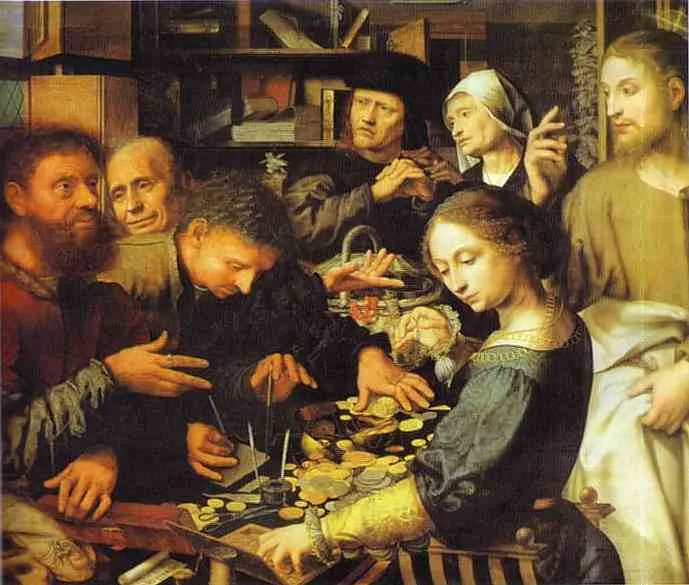
The calling of Matthew
The episode is short in all three synoptic accounts: Christ passes a tax office, sees the man sitting at it, says follow me, and the man rises and follows. Painters made the setting carry the meaning — a counter, coins, ledgers, and the money-handling of the office set against a figure entering from outside. The scene is a calling, not a miracle: nothing happens except that someone stands up.
Its place in the sequence
Early in the ministry, in the phase of gathering disciples that follows the baptism. It belongs with the calling of Peter and Andrew at the lakeside rather than with the later miracles, and it is the episode that puts the fourth evangelist into the story as a participant.
What the record holds
The catalogue gives Jan van Hemessen as the artist and 1536 as the date, with the painting in the Alte Pinakothek, Munich. No dimensions are entered in the record. The style is classed as Northern Renaissance and the artist as Flemish, and the subject fields file the work as a group composition and as religious. The measured palette reads as ochre. Nothing on commission or provenance appears in the entry.
Sources
2 references- Hemessen, Jan Sanders van — Getty ULAN
Early Netherlandish painter, ca. 1500-ca. 1575
- Jan Sanders van Hemessen — Wikipedia
Jan Sanders van Hemessen (c. 1500 – c. 1566) was a leading Flemish Renaissance painter, belonging to the group of Italianizing Flemish painters called the Romanists, who were influenced by Italian Renaissance painting. Van Hemessen had visi